Chase unpaid invoices without chasing them
Check your invoice list every morning and send a polite, escalating reminder at three days overdue, seven days, and fourteen — stopping the moment it's paid.
What this looks like
One step on screen at a time. Read it, do it, tap Next.
Chase unpaid invoices without chasing them
Step 1 of 13
Create the workflow with a daily trigger
Create a workflow and add a Schedule Trigger running once a day, mid-morning. Reminders sent at 3am look automated; ones sent at 10am look like you.
Checkpoint
A daily Schedule Trigger sits on the canvas.
Before you begin
Tick these off as you sort them. Stopping halfway to create an account is how a fifteen-minute build becomes an hour.
0 of 8 ready
Ticks are saved on this device, so you can come back to them.
- Have ready
A Google Sheet with: Invoice, Client, Email, Amount, DueDate, Status, LastReminder. Status holds unpaid or paid.
- Know-how
Format the DueDate column this way before you start. Nothing breaks these workflows more reliably than ambiguous date formats.
- Account
Reminders send from this address, so use the one clients already recognise.
- Have ready
Friendly at day three, direct at day seven, firm with your terms at day fourteen. Drafts are provided; put them in your own words.
- Time
Mechanically this is the simplest paid walkthrough in the library and a good first real build.
The basics — ticked once, remembered everywhere
- Account
Either the hosted version or a self-hosted install. Everything here works the same on both — the only visible difference is the shape of your webhook URLs.
Create a workspace - Know-how
Adding a node, connecting two of them, and pressing Execute. If any of that is new, the free primer covers it in about ten minutes.
- Credential
You will paste at least one secret during setup. A password manager beats a notes app, and it stops you pasting a live key into a chat window by accident.
The shape of the workflow
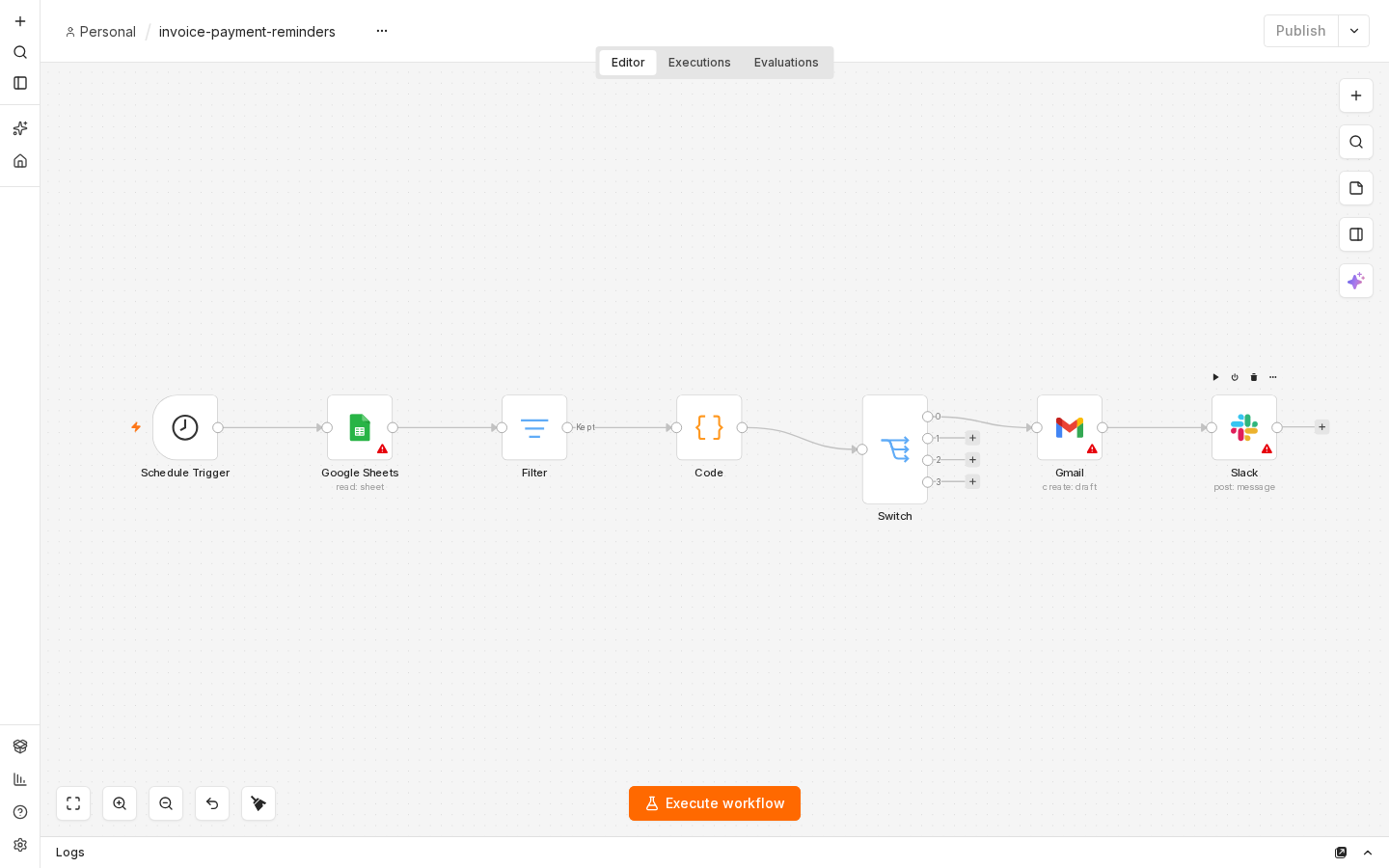
The nodes you will end up with, left to right, in the order you add them.
 4 things to set here
- 1Schedule Trigger — the trigger — everything starts here
- 2Google Sheets — Read the invoice sheet
- 3Filter — Keep only the unpaid, overdue ones
- 4Code — Work out how overdue each one is
Skip the node hunting
Import a starter file with every node for this build already on the canvas, named after its step and wired in order, each one carrying a sticky note with the values to enter. You still connect your own accounts and fill the fields — that is what the walkthrough takes you through — but you never start at a blank canvas.
In n8n: Workflows → Import from file.
What you will build
Jump straight to any step, or print the list and tick it off beside your n8n tab.
- 1Create the workflow with a daily trigger
- 2Read the invoice sheet
- 3Keep only the unpaid, overdue ones
- 4Work out how overdue each one is
- 5Branch on the reminder stage
- 6Write the day-three reminder
- 7Write the day-seven and day-fourteen emails
- 8Record that the reminder went out
- 9Alert yourself at stage three
- 10Dry run, then activate
- 11Create three fake invoices
- 12Run it twice
- 13Mark one paid
If something goes wrong
Everything ready?
Start walkthrough