Turn scattered meeting notes into one tracked status view
Summarise a meeting transcript with AI, log the outcomes and action items in Notion, and post a digest to Slack so nothing said in a meeting quietly disappears.
What this looks like
One step on screen at a time. Read it, do it, tap Next.
Turn scattered meeting notes into one tracked status view
Step 1 of 12
Trigger on incoming transcript emails
Create a workflow and add a Gmail Trigger that watches for new email matching a subject or label you use for meeting transcripts. Only transcripts should reach this workflow — a noisy inbox
Checkpoint
A Gmail Trigger node sits on the canvas, scoped to a specific label.
Before you begin
Tick these off as you sort them. Stopping halfway to create an account is how a fifteen-minute build becomes an hour.
0 of 10 ready
Ticks are saved on this device, so you can come back to them.
- Have ready
Columns for Task, Owner, Due Date, Meeting, and Status. This is where every action item will land, one row per item.
- API key
Used to turn a raw transcript into a structured summary and action list. Any model with a large enough context window for a full transcript works.
- Credential
Share the database with the integration in Notion, or n8n will authenticate fine but see no pages.
- Permission
Somewhere the wider team already looks, not a channel created specially for this workflow and then ignored.
- Account
Whether that's a meeting tool emailing a transcript automatically, or you forwarding notes yourself.
- Have ready
Messy, real notes — not a tidy example — so you can see how the summary copes with actual meeting chat.
- Time
Most of the time goes into getting the AI prompt to return items in a shape Notion can accept.
The basics — ticked once, remembered everywhere
- Account
Either the hosted version or a self-hosted install. Everything here works the same on both — the only visible difference is the shape of your webhook URLs.
Create a workspace - Know-how
Adding a node, connecting two of them, and pressing Execute. If any of that is new, the free primer covers it in about ten minutes.
- Credential
You will paste at least one secret during setup. A password manager beats a notes app, and it stops you pasting a live key into a chat window by accident.
The shape of the workflow
The nodes you will end up with, left to right, in the order you add them.
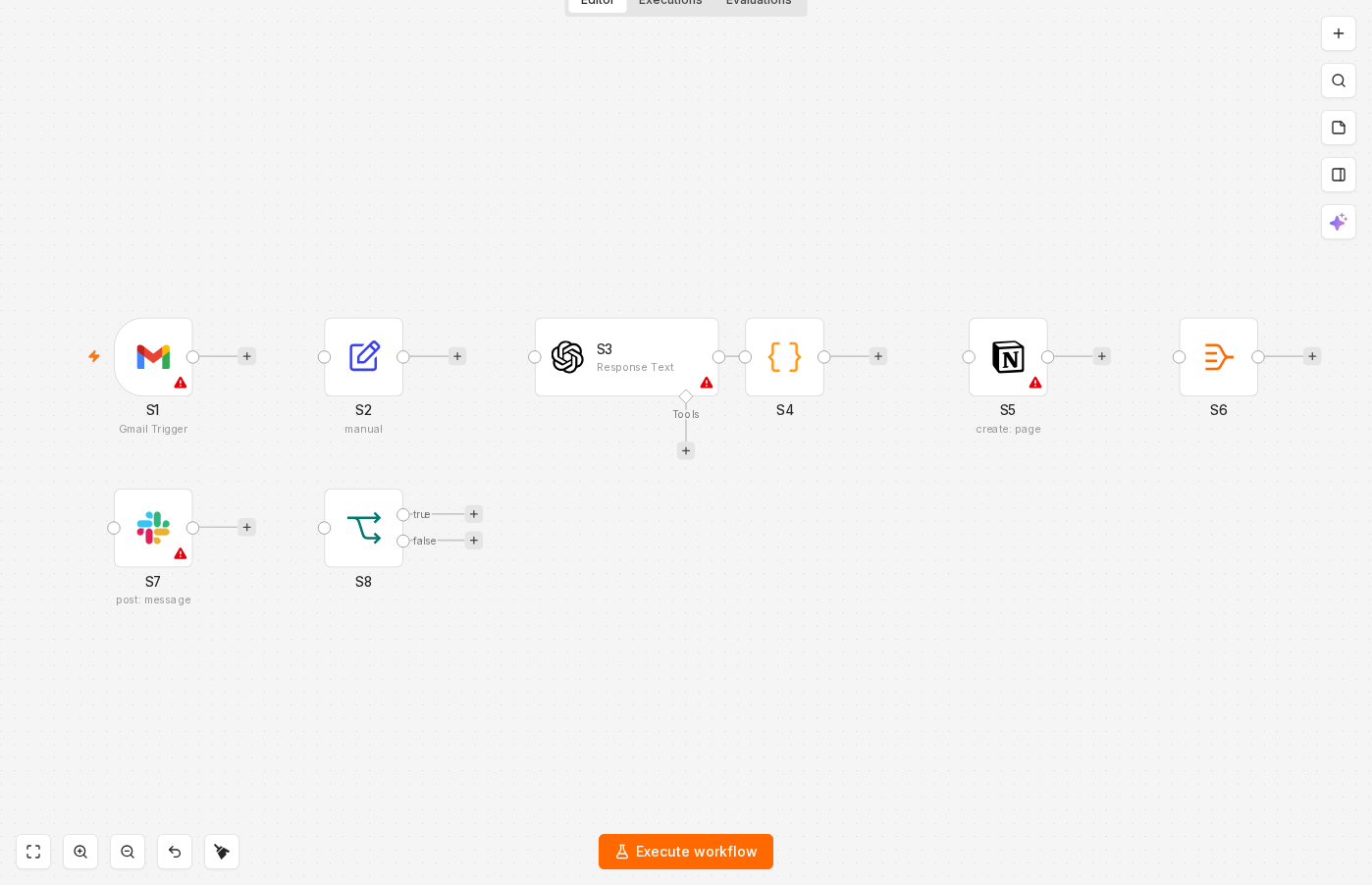 4 things to set here
- 1Gmail Trigger — the trigger — everything starts here
- 2Edit Fields (Set) — Pull out the transcript text
- 3OpenAI — Summarise the meeting with OpenAI
- 4Code — Parse the AI response into rows
Skip the node hunting
Import a starter file with every node for this build already on the canvas, named after its step and wired in order, each one carrying a sticky note with the values to enter. You still connect your own accounts and fill the fields — that is what the walkthrough takes you through — but you never start at a blank canvas.
In n8n: Workflows → Import from file.
What you will build
Jump straight to any step, or print the list and tick it off beside your n8n tab.
- 1Trigger on incoming transcript emails
- 2Pull out the transcript text
- 3Summarise the meeting with OpenAI
- 4Parse the AI response into rows
- 5Log each action item in Notion
- 6Collapse the items back down for one digest
- 7Post the digest to Slack
- 8Handle transcripts with nothing actionable
- 9Test with a real transcript, then activate
- 10Send yourself a transcript with three clear action items
- 11Send a transcript with no action items
- 12Send a very long, rambling transcript
If something goes wrong
Everything ready?
Start walkthrough