Let AI sort your support tickets before your team does
Read every incoming support ticket, work out how urgent it is and who should handle it, then route it to the right place in your CRM automatically.
What this looks like
One step on screen at a time. Read it, do it, tap Next.
Let AI sort your support tickets before your team does
Step 1 of 12
Trigger on new tickets
Create a workflow and add a trigger matching your ticket source — a Webhook node if your helpdesk can send one, or a CRM-specific trigger such as HubSpot Trigger on ticket creation.
Checkpoint
Submitting a test ticket produces one item with the ticket subject and body.
Before you begin
Tick these off as you sort them. Stopping halfway to create an account is how a fifteen-minute build becomes an hour.
0 of 9 ready
Ticks are saved on this device, so you can come back to them.
- Have ready
This could be a support inbox, a webhook from your helpdesk tool, or a CRM ticket-created trigger. You need somewhere tickets already land.
- Account
This is where triaged tickets get their priority and owner fields updated.
- Credential
Set this up as an n8n credential before you start building the routing steps.
- Know-how
Decide up front which categories exist (e.g. billing, technical, access) and which team or person owns each one, plus what counts as urgent.
- Have readyOptional
High-priority tickets get posted here immediately so nothing critical waits for someone to check the CRM.
- Time
Most of the effort goes into writing a triage prompt that matches how your team actually prioritises work.
The basics — ticked once, remembered everywhere
- Account
Either the hosted version or a self-hosted install. Everything here works the same on both — the only visible difference is the shape of your webhook URLs.
Create a workspace - Know-how
Adding a node, connecting two of them, and pressing Execute. If any of that is new, the free primer covers it in about ten minutes.
- Credential
You will paste at least one secret during setup. A password manager beats a notes app, and it stops you pasting a live key into a chat window by accident.
The shape of the workflow
The nodes you will end up with, left to right, in the order you add them.
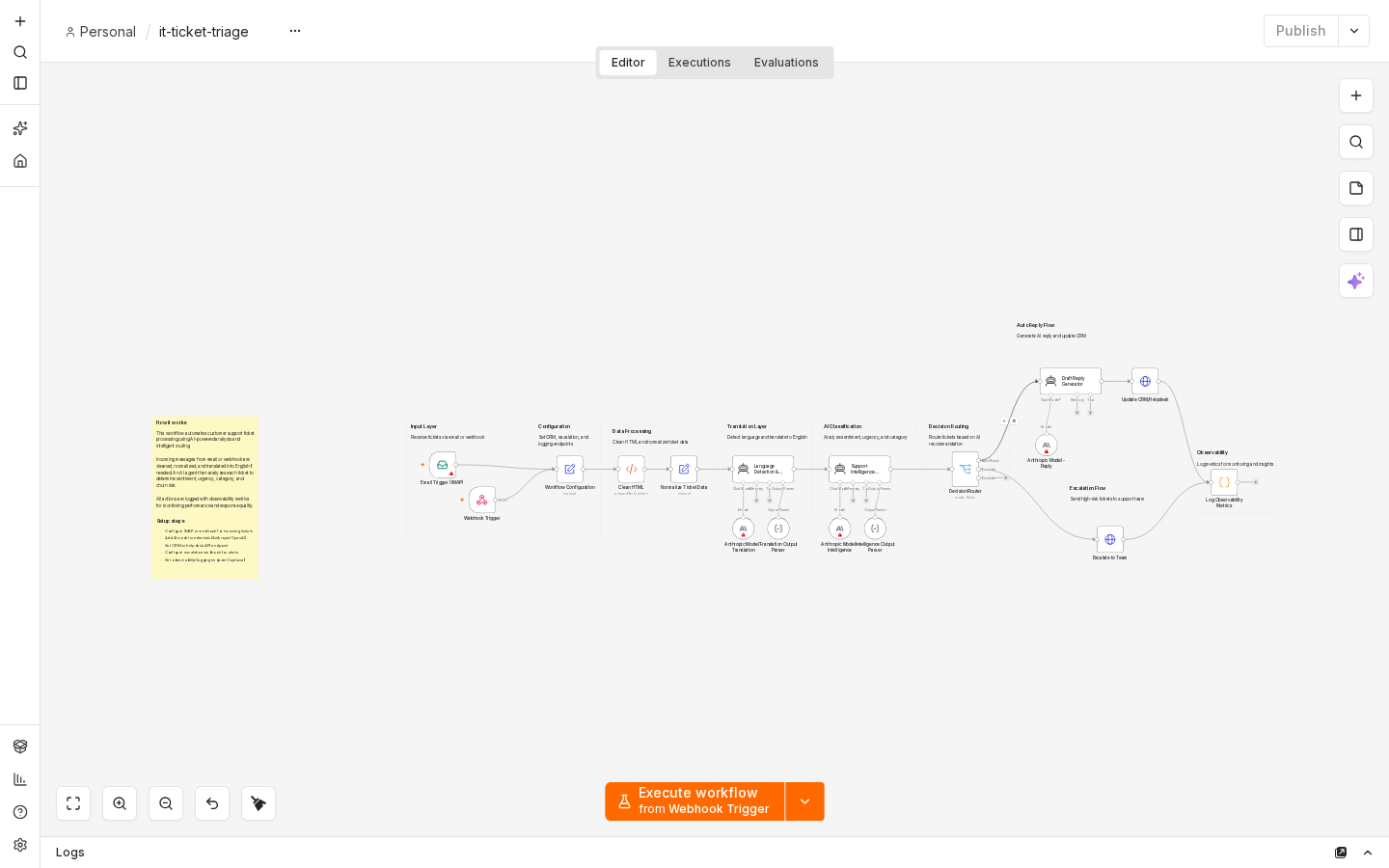 4 things to set here
- 1Webhook — the trigger — everything starts here
- 2Set — Normalise the ticket fields
- 3Anthropic — Ask Claude to triage the ticket
- 4Code — Parse the triage response
Skip the node hunting
Import a starter file with every node for this build already on the canvas, named after its step and wired in order, each one carrying a sticky note with the values to enter. You still connect your own accounts and fill the fields — that is what the walkthrough takes you through — but you never start at a blank canvas.
In n8n: Workflows → Import from file.
What you will build
Jump straight to any step, or print the list and tick it off beside your n8n tab.
- 1Trigger on new tickets
- 2Normalise the ticket fields
- 3Ask Claude to triage the ticket
- 4Parse the triage response
- 5Update the ticket in your CRM
- 6Route the ticket to the right owner
- 7Assign the ticket owner in the CRM
- 8Alert Slack immediately for urgent tickets
- 9Test across categories and priorities, then activate
- 10Submit an obviously urgent ticket
- 11Submit a low-priority ticket
- 12Submit an ambiguous ticket
If something goes wrong
Everything ready?
Start walkthrough