Build a support agent that answers from your own docs
Give customers a Telegram bot that answers questions using your actual documentation, retrieved from a Pinecone vector store, instead of the model's general knowledge.
What this looks like
One step on screen at a time. Read it, do it, tap Next.
Build a support agent that answers from your own docs
Step 1 of 13
Build the indexing workflow first
Create a separate workflow to load your documents into Pinecone before building the chat agent. Start with a Manual Trigger or Google Drive Trigger pointing at your docs folder.
Checkpoint
A trigger is in place ready to pull in your documentation files.
Before you begin
Tick these off as you sort them. Stopping halfway to create an account is how a fifteen-minute build becomes an hour.
0 of 9 ready
Ticks are saved on this device, so you can come back to them.
- API key
Used for both generating embeddings and answering questions once relevant documents are retrieved.
OpenAI API keys - Account
Create an index matching your embedding model's dimensions before you start — 1536 for OpenAI's common embedding models.
Pinecone - API key
Found in your Pinecone project settings.
- Have ready
PDFs, plain text or markdown files work best. Gather these before building — this workflow needs real content to index against.
- Know-how
Retrieval-augmented generation means looking up relevant text before asking the model to answer, rather than trusting it to already know your specifics.
The basics — ticked once, remembered everywhere
- Account
Either the hosted version or a self-hosted install. Everything here works the same on both — the only visible difference is the shape of your webhook URLs.
Create a workspace - Know-how
Adding a node, connecting two of them, and pressing Execute. If any of that is new, the free primer covers it in about ten minutes.
- Credential
You will paste at least one secret during setup. A password manager beats a notes app, and it stops you pasting a live key into a chat window by accident.
The shape of the workflow
The nodes you will end up with, left to right, in the order you add them.
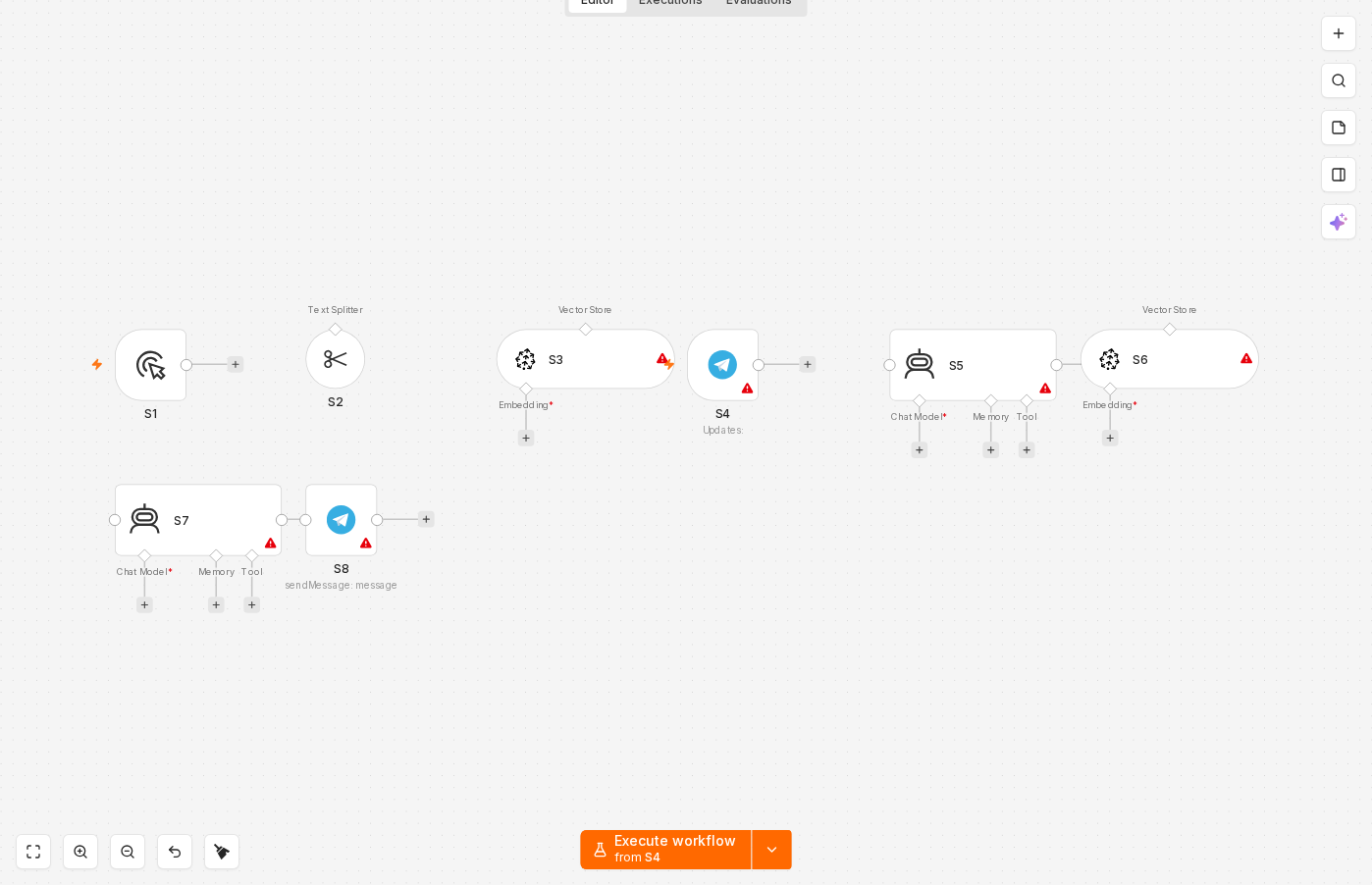 4 things to set here
- 1Manual Trigger — the trigger — everything starts here
- 2Recursive Character Text Splitter — Split documents into chunks
- 3Pinecone Vector Store — Generate embeddings and store them in Pinecone
- 4Telegram Trigger — Start the second workflow with a Telegram trigger
Skip the node hunting
Import a starter file with every node for this build already on the canvas, named after its step and wired in order, each one carrying a sticky note with the values to enter. You still connect your own accounts and fill the fields — that is what the walkthrough takes you through — but you never start at a blank canvas.
In n8n: Workflows → Import from file.
What you will build
Jump straight to any step, or print the list and tick it off beside your n8n tab.
- 1Build the indexing workflow first
- 2Split documents into chunks
- 3Generate embeddings and store them in Pinecone
- 4Start the second workflow with a Telegram trigger
- 5Add the AI Agent node
- 6Connect Pinecone as a retrieval tool
- 7Feed the customer's message into the Agent
- 8Send the answer back over Telegram
- 9Handle the 'don't know' case honestly
- 10Test broadly, then activate
- 11Ask a question with a clear, documented answer
- 12Ask a question outside your documentation entirely
- 13Ask the same question worded two different ways
If something goes wrong
Everything ready?
Start walkthrough